
How Thick Should a Concrete Driveway Be in Kitchener, Ontario?
A concrete driveway in Kitchener should generally be 5 to 6 inches thick. Learn what the City requires and when additional thickness is justified.
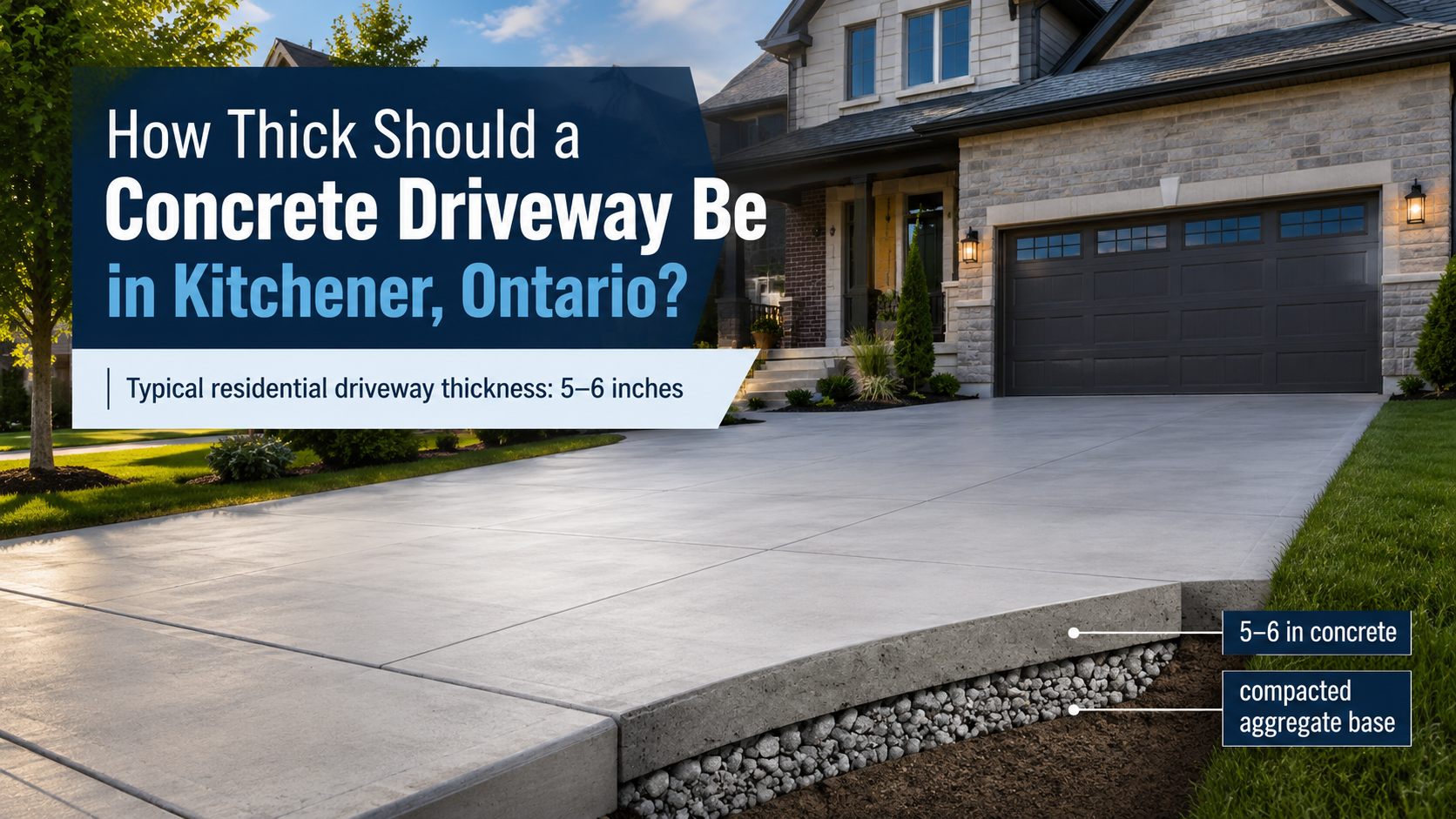
SEO title: How Thick Should a Concrete Driveway Be in Kitchener, Ontario?
URL slug: how-thick-should-concrete-driveway-be-kitchener
Meta description: A concrete driveway in Kitchener should generally be 5 to 6 inches thick. Learn what the City requires and when additional thickness is justified.
How Thick Should a Concrete Driveway Be in Kitchener, Ontario?
A residential concrete driveway in Kitchener will generally be approximately 5 to 6 inches thick, depending on the vehicles using it, the condition of the soil and the preparation beneath the concrete.
For an ordinary household driveway carrying passenger cars and light SUVs, a properly constructed 5-inch slab may be suitable. A 6-inch slab is the safer choice when the driveway will regularly support pickup trucks, work vans, trailers, RVs or other heavier vehicles.
However, slab thickness is only one part of a durable concrete driveway. A thick slab poured over a weak, poorly drained or improperly compacted base can still settle and crack.
What Does the City of Kitchener Require?
The distinction between the private portion of a driveway and the municipal driveway entrance is important.
The City of Kitchener’s Development Manual specifies the following minimum standard for a residential concrete driveway entrance:
- 150 mm of concrete
- 150 mm of Granular A base
A 150 mm concrete slab is approximately 5.9 inches thick, which is normally rounded to six inches. The same City document specifies 200 mm of concrete and 200 mm of Granular A for high-density residential, commercial and industrial entrances. (City of Kitchener)
This requirement applies specifically to the driveway entrance or ramp associated with municipal development standards. It should not automatically be interpreted as a universal bylaw requiring every part of every private residential driveway in Kitchener to be six inches thick.
For homeowners comparing concrete driveway estimates, the important question is not simply, “Does the contractor pour five or six inches?” It is whether the proposed slab, base and drainage plan are appropriate for the property.
Is Five Inches Thick Enough for a Concrete Driveway?
A 5-inch concrete driveway can be sufficient for normal passenger vehicles when several conditions are met:
- The existing organic soil and unstable material are removed.
- The subgrade is firm and properly graded.
- A suitable aggregate base is installed and compacted.
- Water drains away instead of collecting beneath or beside the slab.
- Control joints are correctly placed.
- The concrete is properly finished and cured.
Five inches provides approximately 25% more concrete depth than a four-inch slab. That additional thickness can improve load capacity and provide more tolerance for minor variations in the base.
It is not, however, a substitute for proper excavation and compaction.
When Should a Driveway Be Six Inches Thick?
A 6-inch concrete slab should be considered when a driveway will regularly accommodate:
- Full-size pickup trucks
- Commercial vans
- Work trailers
- Recreational vehicles
- Delivery or service vehicles
- Multiple heavy vehicles parked in the same area
Six inches may also be justified where soil conditions are poor, the driveway edges cannot be fully supported or the property has a history of settlement and drainage problems.
The extra concrete increases material cost, but it is generally cheaper to build the required capacity during the original installation than to remove and replace an undersized driveway later.
A competent contractor should recommend thickness based on the expected use of the driveway rather than quoting the same specification for every property.
Why the Aggregate Base Matters
The concrete is the visible part of the driveway, but the structure beneath it frequently determines how well it performs.
Kitchener’s municipal specifications call for a minimum 150 mm Granular A base for residential driveway entrances. They also require soft or spongy subgrade areas to be removed and replaced with suitable material. Under the City specification, the aggregate base is compacted to 100% Standard Proctor Dry Density.
A private driveway does not necessarily need to copy every municipal construction specification. Nevertheless, the principle is sound: the concrete must be placed over a stable, uniform and well-compacted foundation.
An inadequate base can contribute to:
- Uneven settlement
- Low spots and standing water
- Slab movement
- Cracks at unsupported edges
- Damage during freezing and thawing
- Separation between driveway sections
Adding another inch of concrete will not correct unstable soil or poor drainage underneath the slab.
Kitchener’s Freeze-Thaw Conditions
Exterior concrete in Kitchener is exposed to freezing temperatures, snow, moisture and de-icing products. Water entering the concrete or collecting below the slab can freeze, expand and contribute to surface or structural damage.
The City of Kitchener’s January 2026 concrete specifications require concrete supplied under the municipal specification to include:
- C-2 exposure classification
- A maximum water-to-cementing-material ratio of 0.45
- Air entrainment of 5% to 8%
- Minimum compressive strength of 32 MPa at 28 days
These are municipal project specifications rather than a blanket rule for all private driveways. They nevertheless demonstrate that durability depends on more than slab depth.
For exterior concrete in Southern Ontario, the concrete mixture, air entrainment, water content, placement conditions and curing procedure are all significant.
Does Rebar Prevent a Concrete Driveway From Cracking?
Rebar or welded wire reinforcement may help hold sections together and control how far a crack opens. It does not guarantee that a driveway will remain completely crack-free.
Concrete naturally shrinks as it hardens and dries. Temperature changes and movement beneath the slab can also create stress. The National Ready Mixed Concrete Association states that concrete cracking cannot be prevented entirely, but properly designed joints can control and minimize uncontrolled cracks. It also notes that wire mesh does not prevent cracking; its primary benefit is helping keep cracks from opening. (NRMCA)
Reinforcement should therefore be treated as one component of the driveway design—not as compensation for poor base preparation or inadequate joint placement.
When reinforcement is used, it must be correctly positioned within the slab. Steel left lying at the bottom of the excavation offers much less value than reinforcement properly supported in its intended location.
Control Joints Are Not Optional
Control joints create planned weak points so shrinkage cracks are more likely to occur in straight, intentional locations.
The NRMCA recommends maximum joint spacing of approximately 24 to 36 times the slab thickness and recommends limiting joint spacing to no more than 15 feet. It also recommends keeping panels square or nearly square and cutting contraction joints to at least one-quarter of the slab thickness. (NRMCA)
Kitchener’s municipal concrete specifications similarly require contraction joints to be cut to a minimum depth of one-quarter of the slab thickness. (City of Kitchener)
Long, narrow or L-shaped panels are more likely to develop uncontrolled cracks. Joint layout should be planned before concrete placement rather than improvised after the slab is finished.
Should the Edges Be Thicker?
Driveway edges can be vulnerable because they have less support and are more likely to be driven over.
Thickened edges may be appropriate where:
- Vehicles frequently approach from the side
- The driveway is wider than the garage entrance
- The adjoining landscaping is lower than the slab
- Heavy vehicles are expected
- Soil support near the perimeter is uncertain
An edge might be increased beyond the main slab thickness, but a contractor should not use “thickened edges” as a vague selling point. The estimate should identify where the additional depth will be installed and how that area will be supported.
Keeping vehicle tires away from unsupported slab edges remains important, even when the edge is reinforced or thickened.
Questions to Ask a Concrete Driveway Contractor
Before accepting a driveway estimate, ask the contractor to specify:
- The finished concrete thickness
- The planned depth and type of aggregate base
- How the subgrade will be evaluated and compacted
- The concrete strength and exposure specification
- Whether the concrete will be air entrained
- The type and placement of reinforcement
- The control-joint layout
- How drainage and finished elevations will be handled
- The curing procedure
- Whether the municipal driveway entrance is included
A quote that only advertises “high-strength concrete” or “reinforced concrete” leaves too much unanswered. The contractor should be able to explain the complete driveway assembly.
What Is the Best Concrete Driveway Thickness in Kitchener?
For most Kitchener homes, the practical answer is:
- 5 inches: May be suitable for passenger cars and light residential use when installed over a strong, well-prepared base.
- 6 inches: Recommended for heavier vehicles, more demanding use or when additional structural capacity is warranted.
- Approximately 6 inches at the residential driveway entrance: Consistent with the City of Kitchener’s published 150 mm entrance standard.
The strongest driveway is not automatically the one with the thickest concrete. Long-term performance depends on combining an appropriate slab thickness with proper excavation, aggregate placement, compaction, drainage, jointing and curing.
Request a Concrete Driveway Estimate in Kitchener
Planning a new concrete driveway or replacing a damaged one?
Kitchener Concrete can assess the property, expected vehicle loads, drainage and existing base conditions before recommending an appropriate driveway specification.
Contact us to request an estimate for a standard broom-finished, exposed aggregate or decorative concrete driveway in Kitchener and the surrounding Waterloo Region.
Suggested featured-image alt text: